

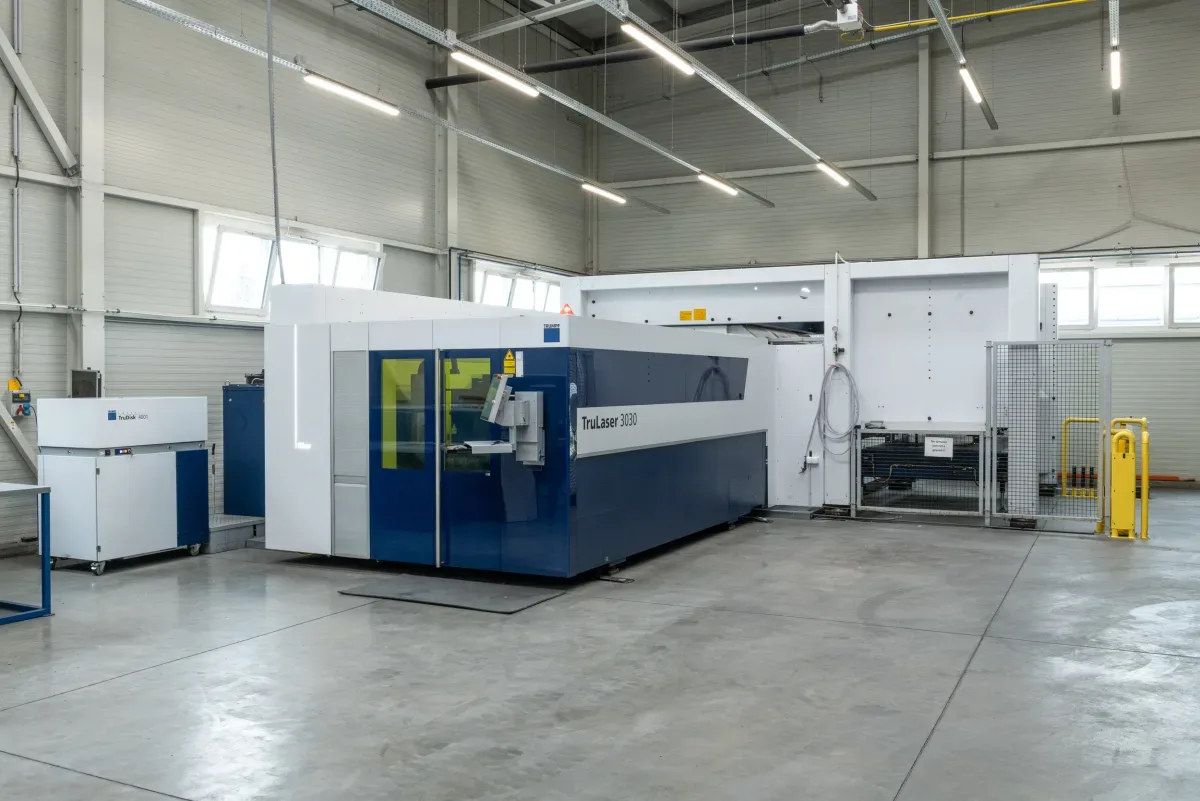
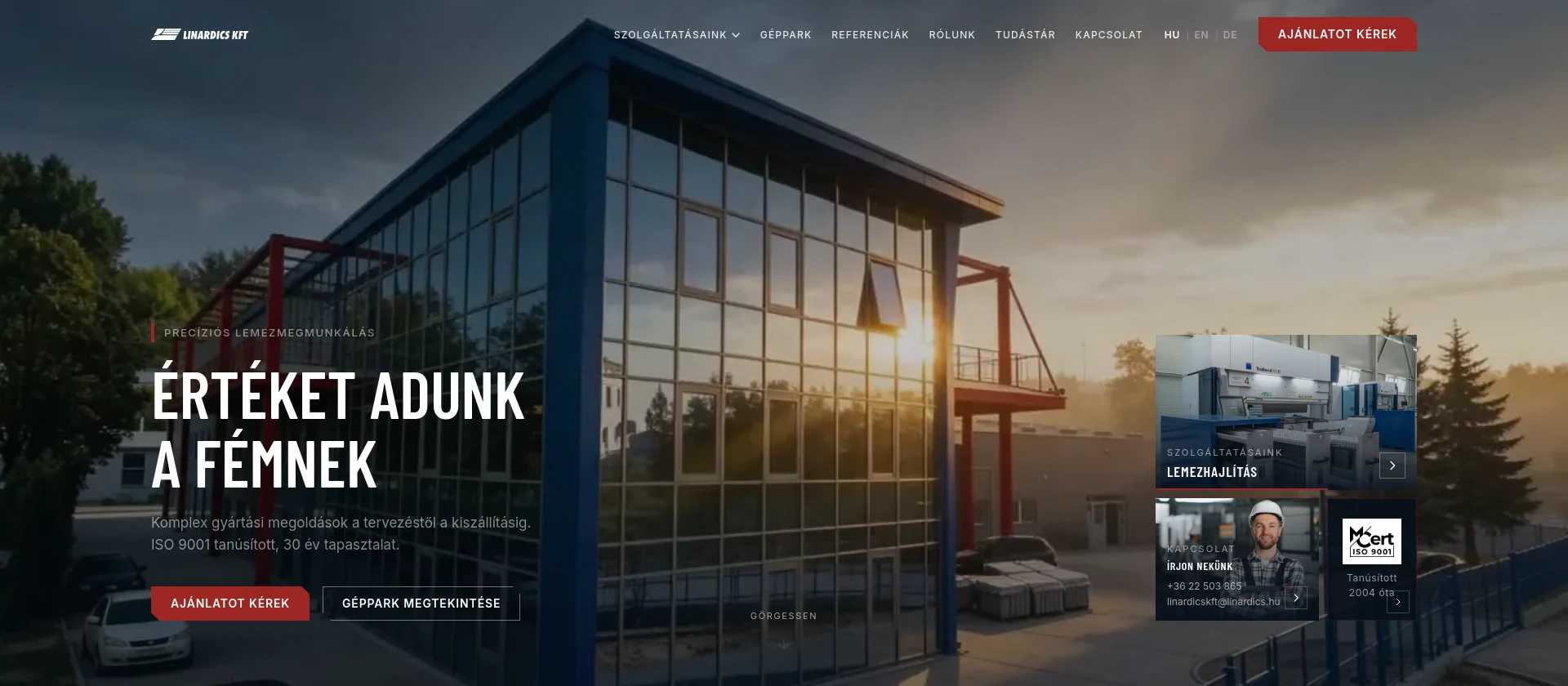
Thirty years of expertise, five technologies, eighteen CNC machines. In contract manufacturing that is the capital — except most company websites show none of it, offering a founding date and a stock photo instead. The first decision in redesigning the Linardics Kft. site was to reverse the order.
Five minutes, and none of them go on the company history
In B2B sheet metal work the decision is not an emotional one. Buyers arrive with specific questions: what machines are on the shop floor, how large a sheet can be cut, what tolerances are held, whether there is an ISO 9001 behind it, and how long a quote takes. If they cannot find the answers within five minutes they do not send an email — they move on to the next supplier.
That behaviour runs against how most industrial websites are built. The usual structure opens with the company history, lists services in general terms, and buries the technical data — if it publishes it at all — on the deepest sub-page. The visitor meets what they came for in exactly the wrong order.
For Linardics this was not a theoretical question. The company has been making precision sheet metal parts in the Sóstó Industrial Park in Székesfehérvár since 1994, and a significant share of orders comes from Austria and Germany. The expertise was there — it just was not visible. So the job was not a "redesign" but a reordering.
Eighteen data sheets instead of sixteen machine names
On the previous 2014 WordPress site the machinery was a single accordion: sixteen rows, one name per machine. No photo, no technical data, no filtering. Anyone looking for tube laser cutting could read all sixteen — and still not learn what power the machine runs at.
On the new site the machinery is a filterable surface of its own. Eighteen machines grouped by technology, each card carrying a photo, the manufacturer and the single figure the decision needs — power, tonnage, or the fact that it is a combi machine. The filter shows counts, so one glance tells you whether there is any tube bending capacity at all.
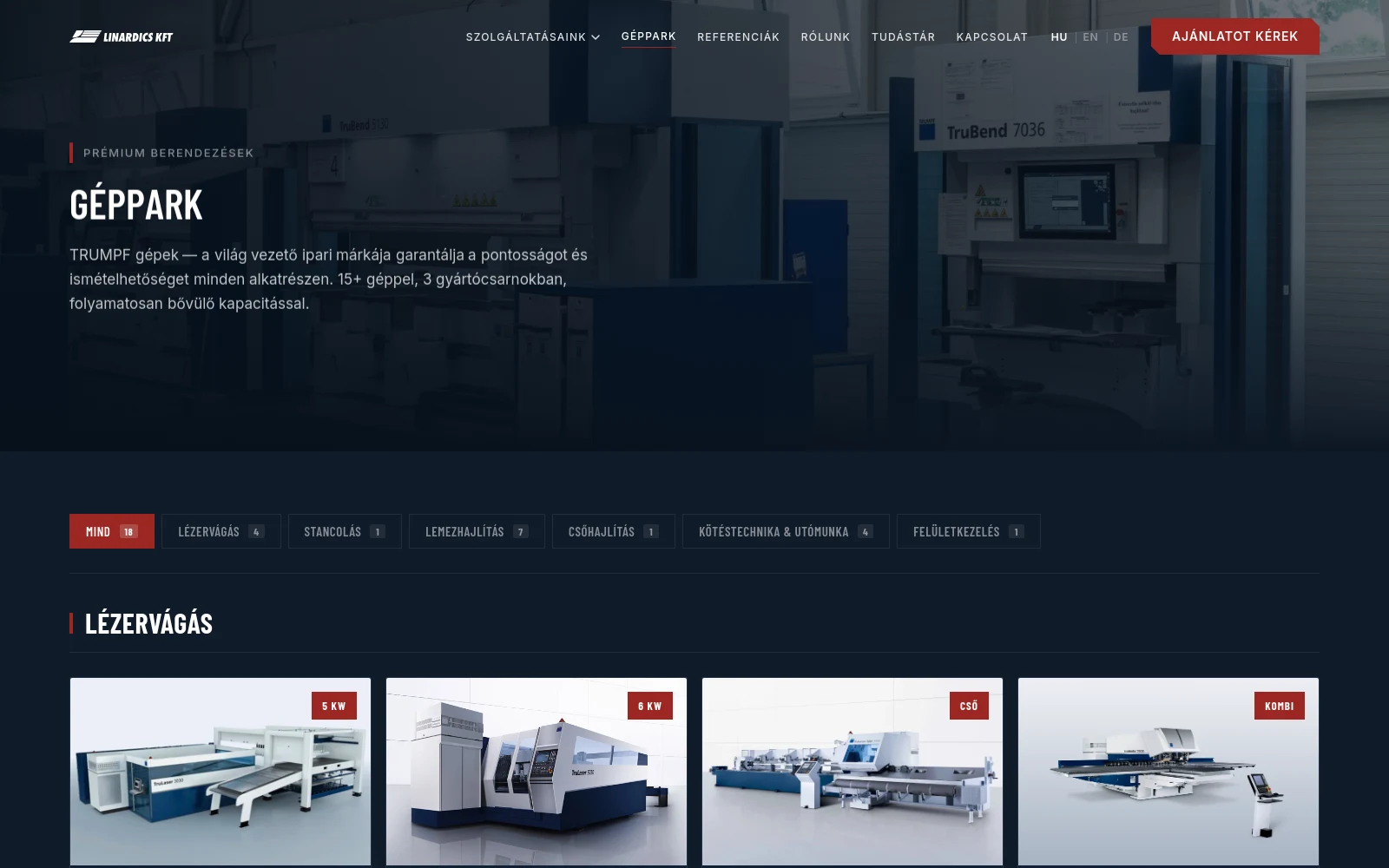
The photography had two different jobs. The catalogue shot — white background, consistent angle — is there so a buyer recognises the machine they are looking for at a glance. The on-site shot is there because it proves something: the machine really exists, it runs, and the shop floor around it is in order. At a contract manufacturer those two together answer a question nobody asks out loud.
"The hard part was never the look — it was the structure. How do eighteen machines, fifteen services and three languages connect so that adding one new machine is not a developer task?"
Tamás Biró, lead developer, KUTASSY
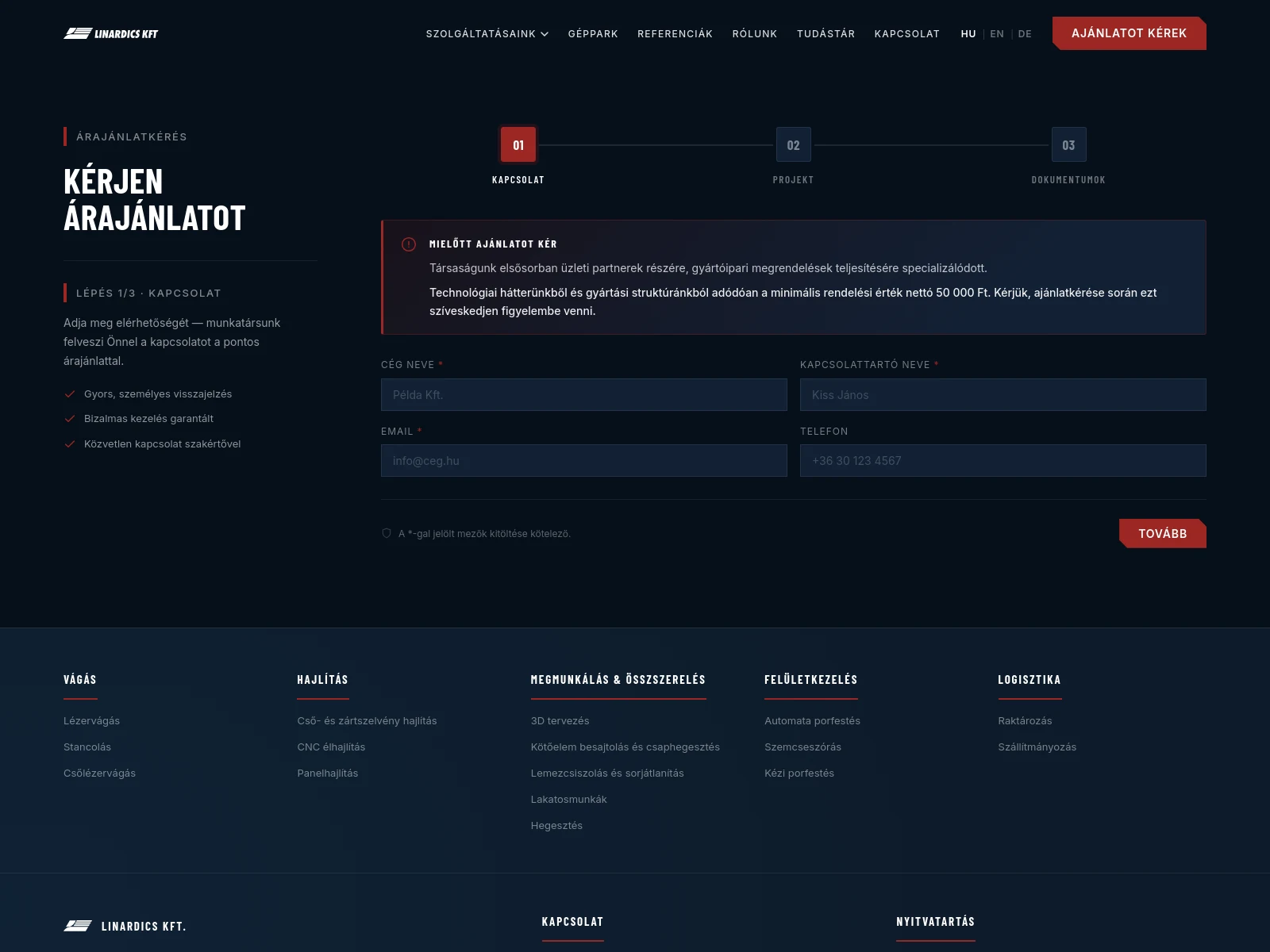
The quote form does not collect data, it protects time
The client interviews surfaced a sharp split. Large buyers send procurement emails around so every supplier quotes on the same basis — a form will never catch them, and it is not worth trying. Smaller, one-off customers do fill in forms, but rarely with the handful of details needed to price the job.
Every one of those incomplete enquiries means a call and a conversation — man-hours spent before anyone knows whether it is worth pursuing. So the form states the net HUF 50,000 minimum before you start filling it in, and asks for project data up front. It is not screening the customer, it is protecting the manufacturer's time — and it also spares the buyer from waiting on a quote for work this manufacturer does not take on.
The three steps — contact details, project data, drawing upload — became three steps because of the bounce rate. On one screen, the sheer number of fields needed for qualification would scare off even the people who would otherwise complete it.
Three languages, one routing table
The site's base language is Hungarian, but the market is Austria and Germany. This was the hardest technical part of the project, and not because there was a lot to translate. One routing table has to feed the navigation, the mega menu, the language switcher, the hreflang and the sitemap, across all three languages. If the switcher and the hreflang build URLs from separate logic, any drift between them throws no error — it just leads to a 404, and you only find out when someone clicks.
The translation, in the end, did not go through an agency. Turnaround would have been too long, and we could not find an agency we fully trusted — in the shadow of AI-generated text, the word "translation" is no longer a guarantee on its own. Instead we worked with AI translation models, and then the client's own salespeople working in each language corrected the mistakes. Technical accuracy does not come from the translator; it comes from the person who sells the product in that language.
What the numbers show
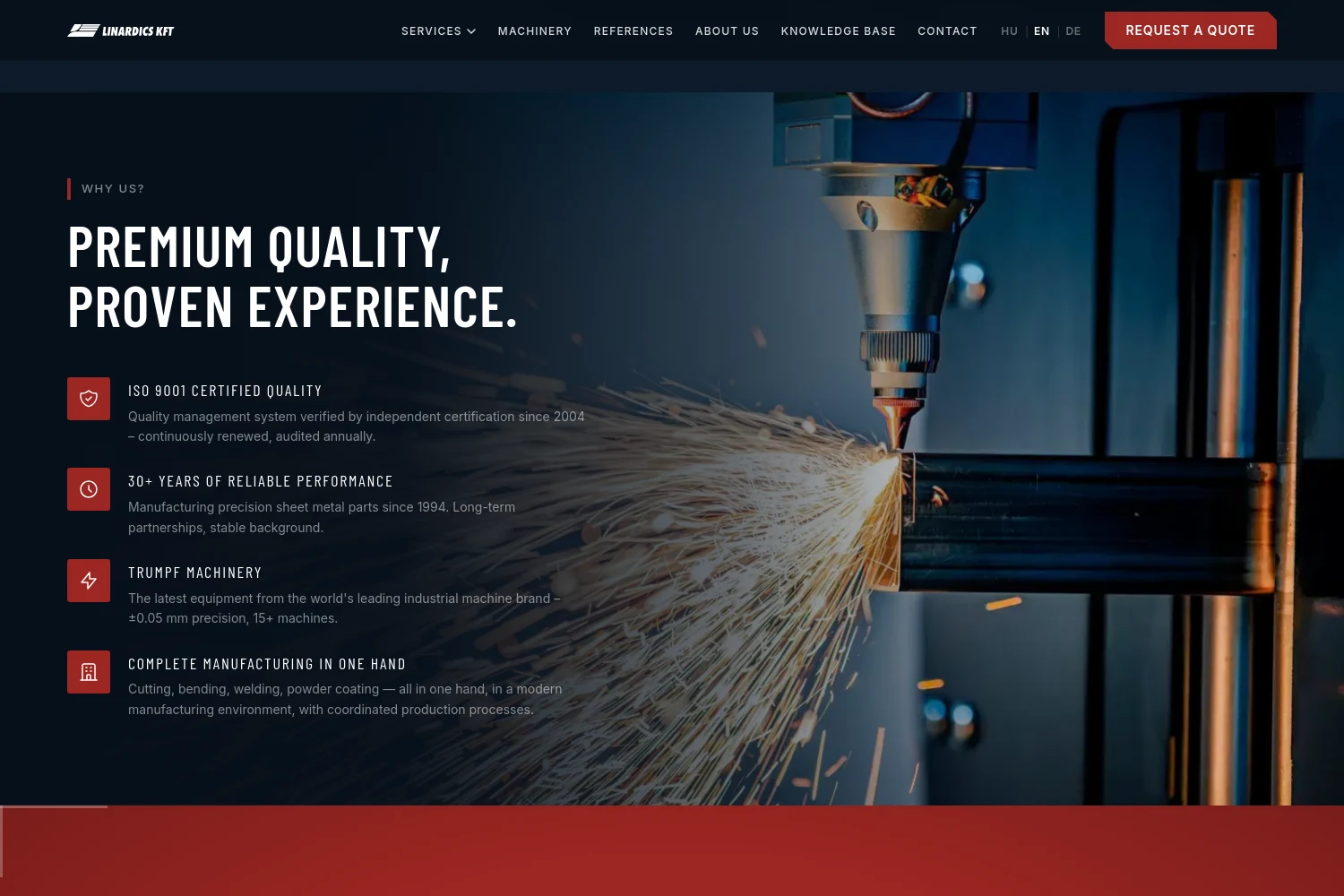
Ten years of accumulated plugins made for a 7.8 MB home page and a 7.6-second LCP, with a layout shift of 0.454. On the new site the home page is 3.0 MB, the LCP is 1.8 seconds and the CLS is 0.032. There was previously no structured data at all — today the Organization, WebSite and LocalBusiness JSON-LD sits statically in the document head, so whether a search engine understands who this is does not depend on the client-side layer.
We did not switch the old site off either, we moved it: the machine specifications came across, and the previous URLs 301 to their new equivalents. Over ten years a domain like this accumulates links and rankings — throwing that away is a loss you get nothing for.
What generalises from this
In contract manufacturing a website is not advertising, it is a qualification surface. Its job is to let the buyer find answers in the order they ask the questions, and to turn incomplete enquiries into usable ones. That is not a copywriting exercise: it means turning existing expertise — machines, parameters, certificates — into searchable, comparable data.
On the Linardics site that meant eighteen machine cards, fifteen service pages with parameters, a three-language routing table and a custom admin. The detail — the design decisions, the measurements and the full developer interview — is in the case study.